
City4Future - Develop Your Own Climate Friendly City!
"City4Future shows what good STEM education is all about: the optimism of being able to master the challenges of tomorrow with scientific expertise, as well as the direct link between research and practice and everyday life", explains Education Minister Dr. Stefanie Hubig.
Where does our energy come from and how is it transformed, transmitted and stored? Is it possible to do this in a completely sustainable way? How can we improve engery efficency issues in our buildings? Can we develop a climate neutral city within 10 years of time?
The research group submerge into these questions from an educational perspective. In cooperation with "Wissensfabrik" and the Wuppertal Institute of Climate, Environment und Energy, the project City4Future aims to create a learning environment that enables learners of science education classes to model future urban spaces via experimentation and exploration. Questions about energy supply, climate change and sustainability are adressed to students. Thus, leading them to an exciting journey towards a sustainable and climate friendly future.
Didactic concept:
The City4Future project is based on a holistic concept that is orientated towards the triad of education for sustainable development. The structure of the modules follows the pattern: ‘Research and analyse - reflect and evaluate - act’ and thus promotes technological understanding and the ability to judge social solutions. In accordance with the approach of research-based learning, students can explore most of the content in an experience-led and self-organised manner and experiment independently. This approach promotes long-term retention of the content and enables transfer to new, more complex situations.
Aims of the project:
- Students develop their own climate-friendly city and thus experience the topics of energy, sustainability and climate change in a concrete and everyday way
- Students learn key skills such as independence, creativity and social skills
- Students gain knowledge about climate change and the physical and technical relationships between energy generation and storage
- Students learn to place this knowledge in a social context and engage in democratic discourse
November 2025 - "City4Future" awarded climate protection prize
On 17 November 2025, the Bamberg Climate and Energy Agency, on behalf of the city and district of Bamberg, awarded the 2025 Climate Protection Prize in the category of organisations, schools or other institutions to the Department of Science Education and all those involved in the City4Future educational project.
The City4Future project, which was developed primarily by the Department of Science Education at the University of Bamberg, combines climate education, sustainability and democratic participation. City4Future is aimed at pupils in years 7 to 10 of all types of secondary school and enables them to design their own climate-friendly cities in an interdisciplinary format. In practice-oriented modules, participants address key issues for the future, such as energy efficiency, renewable energies and their storage, and sustainable urban development, and develop concrete solutions for a sustainable model city based on their own experiments. Through role-playing games, for example, young people develop a broad understanding of issues such as climate justice from regional, national and global perspectives.
The project was particularly praised for its high practical relevance, nationwide transferability and social impact. City4Future is used throughout Germany. The handbook is available as a free OER on the Wissensfabrik website, and experimental materials are also provided to schools free of charge through the education partner principle.
These collaborations show how education, science and business can work together to make effective contributions to climate education.
July 2025 – Semester finale of the City4Future educational project with pupils from Baunach Secondary School
November 2024 – Young Researchers Conference of the City4Future Education Project
Report – Young Researchers Conference
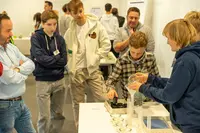
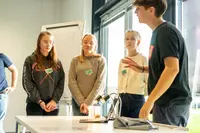
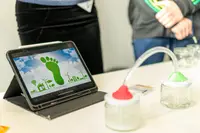
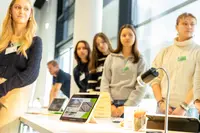
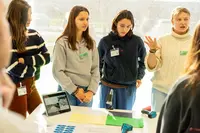
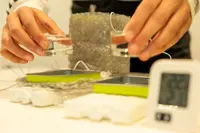
Young Researchers Conference of the City4Future Education Project in Bamberg
The Bavarian pilot project ‘City4Future’ came to a festive conclusion with the first Young Researchers' Conference in Bamberg. ‘City4Future’ is a project of Wissensfabrik - Unternehmen für Deutschland e.V. and was fundamentally revised at the beginning of 2023 by the Department of Science Education. A novel feature of the project was to look at climate change and climate adaptation measures in cities from multiple perspectives in order to find solutions supported by the majority. Pupils use scientific methods in numerous experiments they carry out themselves, thereby gaining crucial insights in a self-organised manner. Creating an open learning environment in which learners can ask questions about climate change that are ‘close to their hearts’ was also a central idea of the revision team at the University of Bamberg.
City4Future is already being used with great success in many federal states throughout Germany via so-called education partnerships. All experimental materials and teacher training courses are free of charge for schools!
On 22 November, seven Bavarian pilot schools from the Bamberg district finally presented their solutions for urban development of the future. This demonstrated how important good STEM education is as a basis and tool for the next generation. The interdisciplinary exchange between schools, business, science and politics on the premises of Brose GmbH was beneficial for all sides.
On Friday, the Bamberg region was the centre of future planning: the first Young Researchers Conference marked the ceremonial conclusion of the pilot phase of the innovative City4Future project. The event was held at Brose in Bamberg, which, together with Bosch as an education partner, played a key role in its implementation.
From idea to innovation: pupils shaping the future
The conference focused on the pupils from the participating schools themselves: almost 50 young people from different types of schools, ranging from Year 5 to Year 11, presented their experiments and ideas, which they had developed at their own schools as part of the City4Future educational project. The direct transfer of the results to their own local environment was particularly impressive. For example, pupils at Baunach Middle School were able to apply their findings on insulating houses to the renovation of their school building. Also participating were Hallstadt Middle School, Steigerwaldrealschule Ebrach, Graf-Stauffenberg Business School, Franz-Ludwig-Gymnasium Bamberg and Kaiser-Heinrich-Gymnasium Bamberg. The young people impressively demonstrated how they were able to tackle the challenges of climate change by implementing the City4Future project and developing their own solutions for sustainable urban development.
A conference marked by appreciation and recognition
In the final round of the conference, the young researchers had the opportunity to ask experts from the fields of climate adaptation, urban development, the environment and politics their own questions, including critical ones. The interdisciplinary exchange on equal terms – between companies, administration, politics, schools and between young and old – sent a strong signal for innovative STEM education and climate protection.
The success of the event is also due in particular to the dedicated work of the teachers who accompanied their students on this journey.
A big thank you goes to all those involved, especially the pupils, the educational partners Brose Group and Bosch Bamberg, political decision-makers such as Deputy District Administrator Bruno Keller and Bamberg's 2nd Mayor Jonas Glüsenkamp, the employees of the climate protection department of the district and the city of Bamberg, and the STEM network of the Bamberg region for their participation and commitment.
Invitation to Young Researchers Conference

University contact person: Dr. Yelva Larsen
Contact person "Wissenfabrik": Dr Markus Riefling: markus.riefling(at)wissensfabrik.de
Project staff: Petra N?gel, Dr Jutta Paulini, Tanja Zacher